Tuesday, January 10, 2012

Today's Major Market Move: OJ Futures Surge Over 10% in Tuesday's Session

If the Duke brothers had been trading today, the movie would've had a different ending. FCOJ futures surged almost 11% today on reports that detection of an unapproved fungicide in Brazil could result in reduced orange juice imports into the US. Here's more color (of an orange hue) from the Chicago Tribune:
The latest surge appeared related to news reports that the Food and Drug Administration had told juice makers that it would step up testing for the fungicide carbendazim, which is used in Brazil but is not authorized for use in the United States. The reports said the FDA had been contacted by an unidentified company that had discovered low levels in its own juice.

"Brazil used it last year supposedly, and it wound up in some of the orange juice of at least one (U.S.) company processing the oranges," said James Cordier, president of Tampa, Florida-based Liberty Trading Group.

"We lost oranges on the freeze last week but this certainly trumps that," he said. "If they ban Brazilian orange juice OJ has ... another 20 to 30 cents on the upside at least."
Not surprisingly, FCOJ futures were the best performing commodity on the day:

Click to go to the live chart.
However take note that Cocoa futures were not far behind with an 8% gain (the difference between Cocoa and Cocoa LI is that LI is priced in GBP). Cocoa had its own dramatic news event when it was announced that a Nigerian work stoppage would threaten global supplies.

If we look a line chart comparison of the prices of the two commodities, we'll see that Cocoa has a ways to go to get back to its 2011 highs whereas FCOJ has broken out to new all time highs.

Click here to go to the live chart.

Monday, January 9, 2012

Today's Major Market Move: Juniper Networks (JNPR) Gains Over 6% in Monday's Session

On a day when US equity markets were basically flat, there were a few standout performers, one of which was Juniper Networks (ticker: JNPR). Stifel Nicolaus released a note stating that they expected JNPR's current quarter results to be in-line. That news propelled the stock price to a 6.5% gain and made it the best performer in the S&P500 on Monday. Here's the list of the top performers:

Click here to go to the live table.

Longer term the picture isn't quite so pretty. JNPR's stock price is down going back to the beginning of 2008 and the company has missed earnings in the last three quarters. Here's a comparison chart of % change of EPS estimates, EPS actuals and stock price.

Click here to go to the live chart.

A big reason for the recent misses is that analysts have over estimated the impact of cloud and mobile computing on network related capital expenditures. The entire networking sector has struggled including Alcatel-Lucent (ticker:ALU) and to a lesser extent Cisco (ticker: CSCO). I suspect that many companies overspent on networking gear prior to 2008 and after the crash were left with plenty of excess capacity, which they are still in process of filling up.

UPDATE: This recent 'feel good' story was short lived as JNPR announced after hours that they were reducing their 4th quarter guidance. More detail from Forbes:
For the quarter, the company now sees revenue of $1.1 billion to $1.2 billion, down from a previously expected $1.16 billion to $1.22 billion. Juniper now sees non-GAAP EPS of 26-28 cents a share, down from 32-36 cents. Non-GAAP operating margin is expected to be below previous guidance of 21%-23%.

The company said the weaker-than-expected results reflects soft router demand from service providers, with a particular weak spot in the U.S.

Even with the bad news, the stock hasn't (yet) given back all of the previous day's gains:

Click here to go to the live chart.

Sunday, January 8, 2012

Today's Major Market Move: Cypriot Stocks Down Over 10% in 2012

While most of Europe is trying to kick off 2012 by shrugging off their problems, Greece and Cyprus continue to struggle. The Greek equity market is down over 10% for the year (we last featured Greece on January 3rd after a one day 2.5% drop), and the Cypriot equity market (which often times acts like a Greek 2X ETF) is down over 16%. Here's the bottom ten benchmark equity indexes for 2012:

Click here to go to the live table.
Fortunately for Europe, only two Eurozone countries show up in that list and only two other Eurozone countries are in the red (Italy and Spain).

The credit default swap market is telling a slightly different story. Out of 15 European and what we call "Fringe European" countries, only 2 have seen the prices for their 5 year CDS drop. Here's the full list:

Click here to go to the live table.

Going back to Cyprus, we might be getting close to the point where their equity market represents a low-risk long opportunity. I say that primarily because it's down 90% since 2007 so how much lower can it go? It's GDP has grown about 50% since then and is projected to rise slightly over the next 4 years. If the GDP estimates hold true, I would expect there to be some recovery in their stock market. Here's the comparison chart of their benchmark equity index against gdp growth (actual and estimated):

Click here to go to the live chart.

Saturday, January 7, 2012

Today's Major Market Move: Austrian 5Y Credit Default Swaps Up 28% Since December 1st

As we kick off 2012, European economies continue to signal weakness, particularly in the credit default swap market. Except for Iceland, every EU and what we call "Fringe EU" country has seen their 5 year credit default swaps go up in price since the beginning of December. Austria's CDS were the top gainers over that time frame, due in no small part to the continued economic turmoil in Hungary (which we last discussed here), to which many Austrian banks have exposure.

Click here to go to the live table.
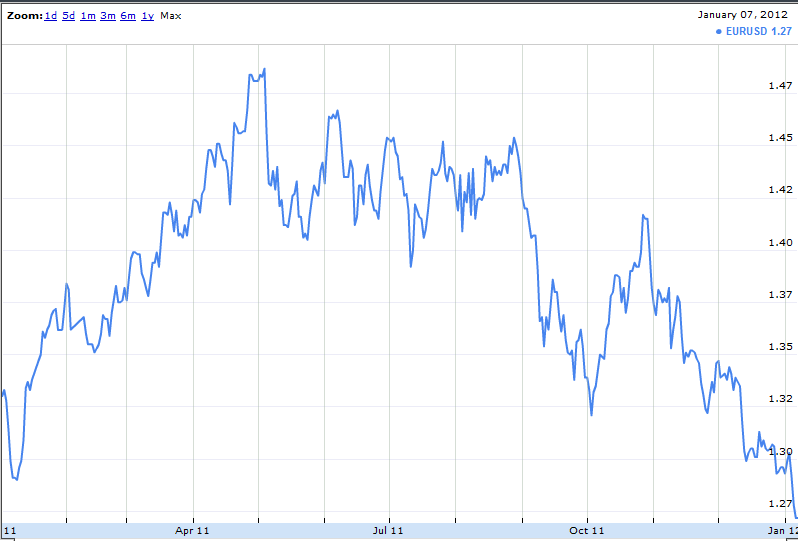
Another omen is the decline of the Euro, with the EURUSD cross down 15% off of the 2011 highs and it recently dropped through the 2011 lows.

Click here to go to the live chart.
And then there's the equity markets where four of the top six declining benchmark equity indexes were from EU and fringe EU countries. Hungary's stock market was the worst performer with a decline of over 16% in a little over a month.

Click here to go to the live table.

Friday, January 6, 2012

Today's Major Market Move: Argentinian Stocks Up 12.5% in 2012

Granted we're only one week into the new year, but the Argentinian stock market is off to a strong start with a gain of 12.5%. That puts it well ahead of the next best performer, Estonia, which is up 4.5%.

Click here to go to the live table.
With Argentina's checkered past with managing its currency, one could hardly be blamed for thinking that equity gains of this magnitude might be at least partly driven by currency devaluation. But lo and behold, it turns out the Peso is flat versus the Dollar over the same time frame. Here's the USDARS cross compared to the benchmark Merval Index:

Click here to go the live chart.

Thursday, January 5, 2012

Today's Major Market Move: Hungarian Stock Market Declines Over 7% in Past Week

Since our last post on Hungary which was less than a week ago on December 30, 2011, economic conditions  there have gone from bad to worse. The Forint has continued to weaken and the equity market has dropped over 7% so far this week, making it the 2nd worst performer after Cyprus:

Click here to go to the live table.

Here's the line chart of the benchmark Hungarian Traded Index going back to the beginning of 2011:

Click here to go to the live chart.

And here's the USDHUF cross over the same time frame:

Click here to go to the live chart.
In both our December 30th post and our December 22nd post, we discussed how Hungary was driving a hard bargain with the IMF and EU over negotiations concerning economic policies and the continuation of financial assistance. As a result of the ongoing deterioration of both the stock market and the currency, the latest news now indicates that the Hungarians are getting ready to cave. From Bloomberg Businessweek:
Jan. 5 (Bloomberg) -- Hungary is ready to discuss conditions for an International Monetary Fund loan and wants to reach a deal “quickly,” the government said after the forint dropped to a record against the euro and a debt sale fell short.

The Cabinet is ready to start negotiations on a standby loan agreement with the IMF and the European Union, Tamas Fellegi, Hungary’s chief negotiator, told reporters in Budapest today. The government wants a precautionary loan to tap only if market conditions require it, he said.

“The government is completely aware of the stakes of financial talks with the IMF and the European Commission,” Fellegi said. “We want a quick agreement.”
The quotes from the Hungarians in that article reek of desperation and it will be interesting to see how much crow they will be forced to eat by the Europeans and the IMF. I doubt they will be forced to repeal the recently passed law that weakened central bank autonomy, but I would not be surprised if it is altered, either on paper on in the course of its implementation.

Wednesday, January 4, 2012

Today's Major Market Move: Eastman Kodak drops 30% in Wednesday's Session

The inexorable march of technological progress claims another buggy whip maker. Today the rumor came out (a rumor so widely dispersed that it verges on news) that Eastman Kodak (ticker: EK) is preparing to file for chapter 11 bankruptcy. The share price, which had already been beaten down to penny stock levels, dropped another 30% in today's session . It is down over 90% since the beginning of 2011:

Click here to go to the live chart.
We discussed EK previously on November 27th. The plan at that time was to try to generate cash from the patents but it appears that the operational cash burn was too much to overcome. There's not much more to read into this from a wider macro economic perspective. It's a simple story really; technology advances and some companies are made obsolete.